Wednesday, March 26, 2014

Engineering Project Report & Presentation

Review “Writing as an Engineer”
http://engr1304.blogspot.com/2014/01/writing-as-engineer.html

The end of the semester is fast approaching!  I am trying to give you enough time to do classwork in class, so that you will have time outside of class to get your project done.

Friendly reminder: Class attendance is 10% of your final grade.  If you miss a class, you need to come in to an extra class (Tu/Th 9:30-12:30, 6:00-9:00).

April 29 Project presentation.
May 1st
   Review for final.
Final Exam: May5-11
Grades due in MyLoneStar (4 pm) May 13


Heading:
Centered on page: Name of your product (pick a catchy name!)
Your name, with date, and" LSC ENGR Project".


The No Totter Water Potter
Jack & Jill, 2014 Spring LSC ENGR Project

1. Introduction (10 points)Briefly state the product you decided to design, what need it will fill, who it will be marketed to, and why you chose this product.

ie – Jack and Jill have refused to go up the hill, so we created a clean drinking water  transportation and containment system to deliver and store fresh hill spring water right inside their own house.

2. Research and Background information (10 points) 

As can be seen on the map in figure 2.1, on top of High Hill at the headwaters of Slippery Stream lies Clearwater Spring.   The spring water is purified through a natural filtration process where the groundwater seeps through rocks and soil (see ref #1).  Etc. etc.  This water was last tested on Nov 28, 2012 by AAAEnviroWet and was found to be exceptionally pure (ref #2).
.
3. Product specifications, diagrams, pictures, and user instructions. (50 points)
Older lead pipes on the High Hill property will need to be removed, and replaced with insulated polyvinyl chloride piping installed according to rhyme building code specifications (2).   A splitter valve will divide the water flow into an above ground black solar hot water pot, and an underground cold water pot where it is stored until needed as shown in figure 3.1.  
.
4. Modifications, testing, and operation procedures.   (20 points)
Water purity, pressure, and temperatures were tested throughout the system at various weather conditions as shown in table 4.1.  After consideration of the data, a pressure relief valve was installed to prevent rupture of the solar heater during hot summer months, and an air injection line was installed to blow water out of lines susceptible to freeze in the winter.   Operating procedures for both summer, and winter months are presented below….
..
6. Conclusions, suggestions for future work. (10 points)Jack and Jill’s new “No Totter Water Potter” network is vast improvement over the previous bucket and muddy path water transportation  system.  Although this new system has many advantages, the spring snowmelt water runoff poses a possible threat to the water purity in late April and May, and future mitigation for this is strongly suggested.  Etc.
.
Reference Section
Correctly formatted, and numbered.


Use the writing tutoring center!
http://engr1304.blogspot.com/2014/03/tutor-schedule.html

Presentation:
Short, sweet, simple, entertaining.


Total presentation should be no longer than 10 minutes.  Bring a USB drive with diagrams, slides, videos of your diagram, etc. to share.  Presentations will be graded by your class peers on enthusiasm, clarity, organization, body language, voice projection, and visual aids.


Practice makes perfect!  Your house presentation will be a test run to prepare you for presenting your semester project in a month.  


Presenter __________________       Grader _______________________


PRESENCE                                                                               5          4          3          2          1          0
      -body language & eye contact
      -poise
-enthusiasm

LANGUAGE SKILLS                                                             5          4          3          2          1          0
      -correct usage
      -appropriate vocabulary and grammar
      -understandable (rhythm, intonation, accent)
      -spoken loud enough to hear easily

ORGANIZATION                                                                    5          4          3          2          1          0
      -clear objectives
      -logical structure
      -signposting ( the way they explain the path that was taken)

MASTERY OF THE SUBJECT                                             5          4          3          2          1          0
      -pertinence
      -depth of commentary
      -spoken, not read
      -able to answer questions

VISUAL AIDS                                                                          5          4          3          2          1          0
      - Clear and understandable
      - Demonstrates proficiency in CAD
     

OVERALL IMPRESSION                                                      5          4          3          2          1          0
      -very interesting / very boring
      -pleasant / unpleasant to listen to
      -very good / poor communication

                                                                                                     TOTAL SCORE  _______ / 30


List Strengths:

List at least one area for improvement:


Monday, March 24, 2014

Perspectives & animation.


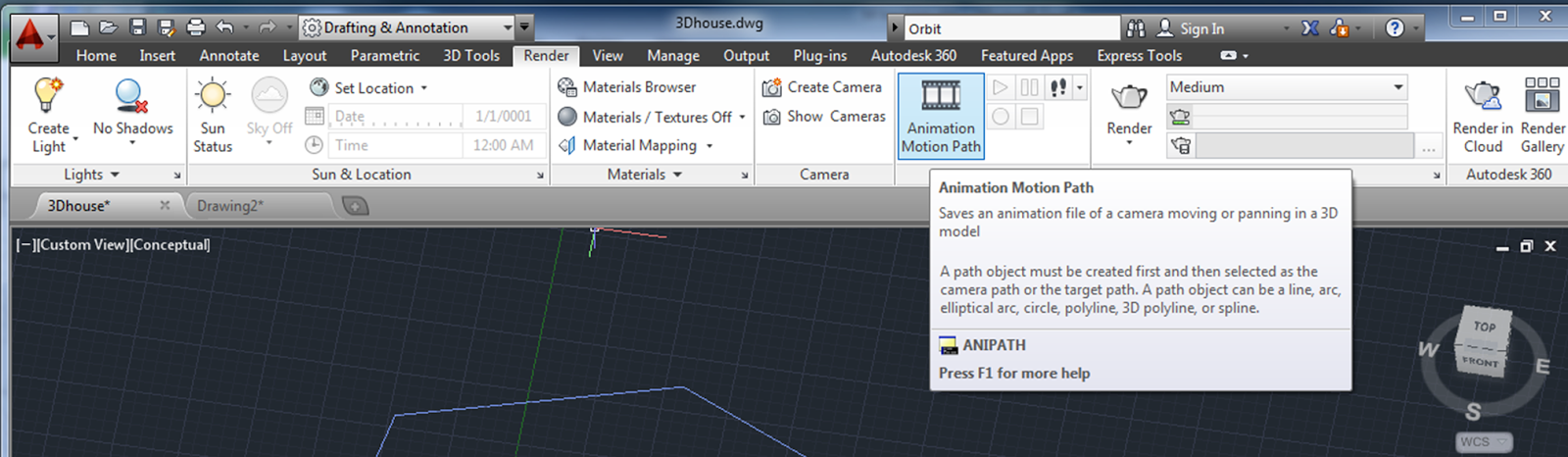
Materials:  Right click on the grey bar to get the Render tab, and check out all of the tools in it.


3D Hatch:


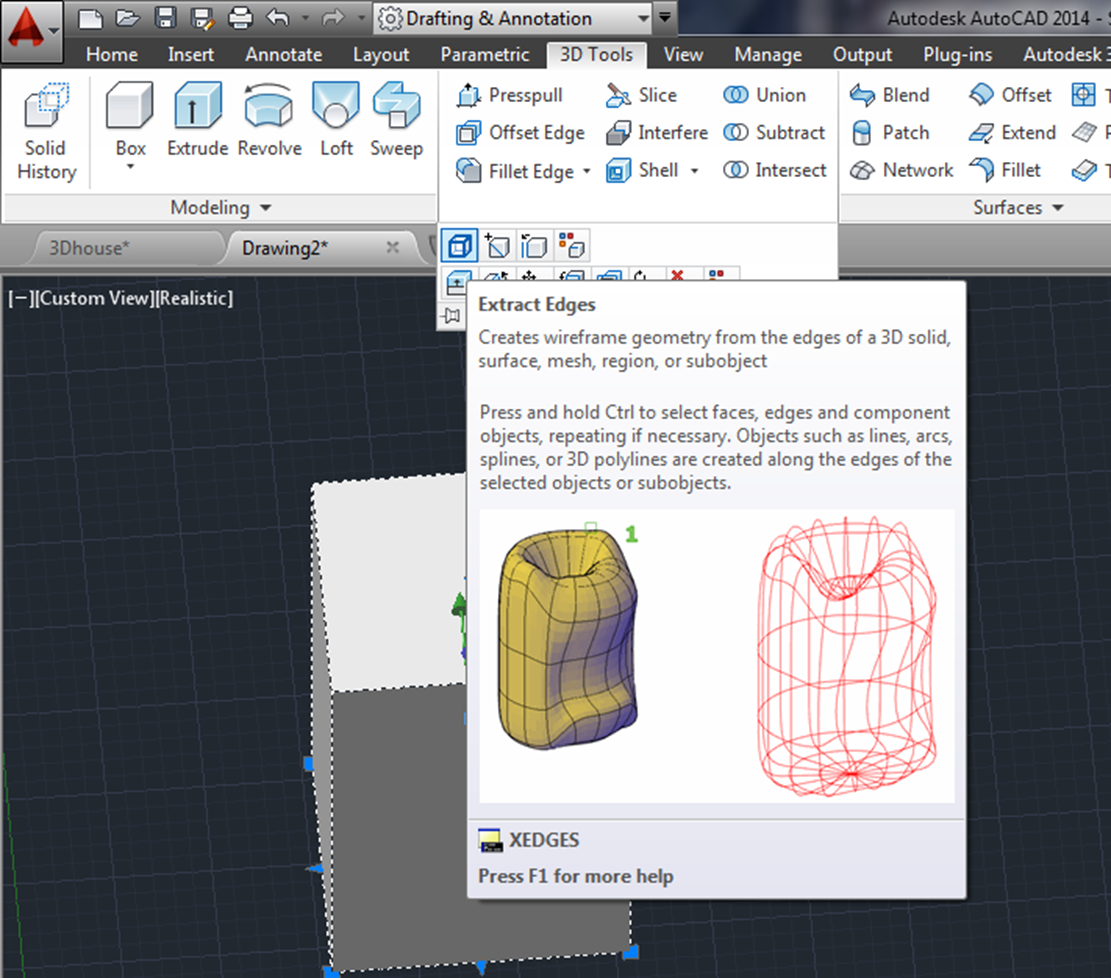
Extract the Edges of your 3D solid:
XEDGES


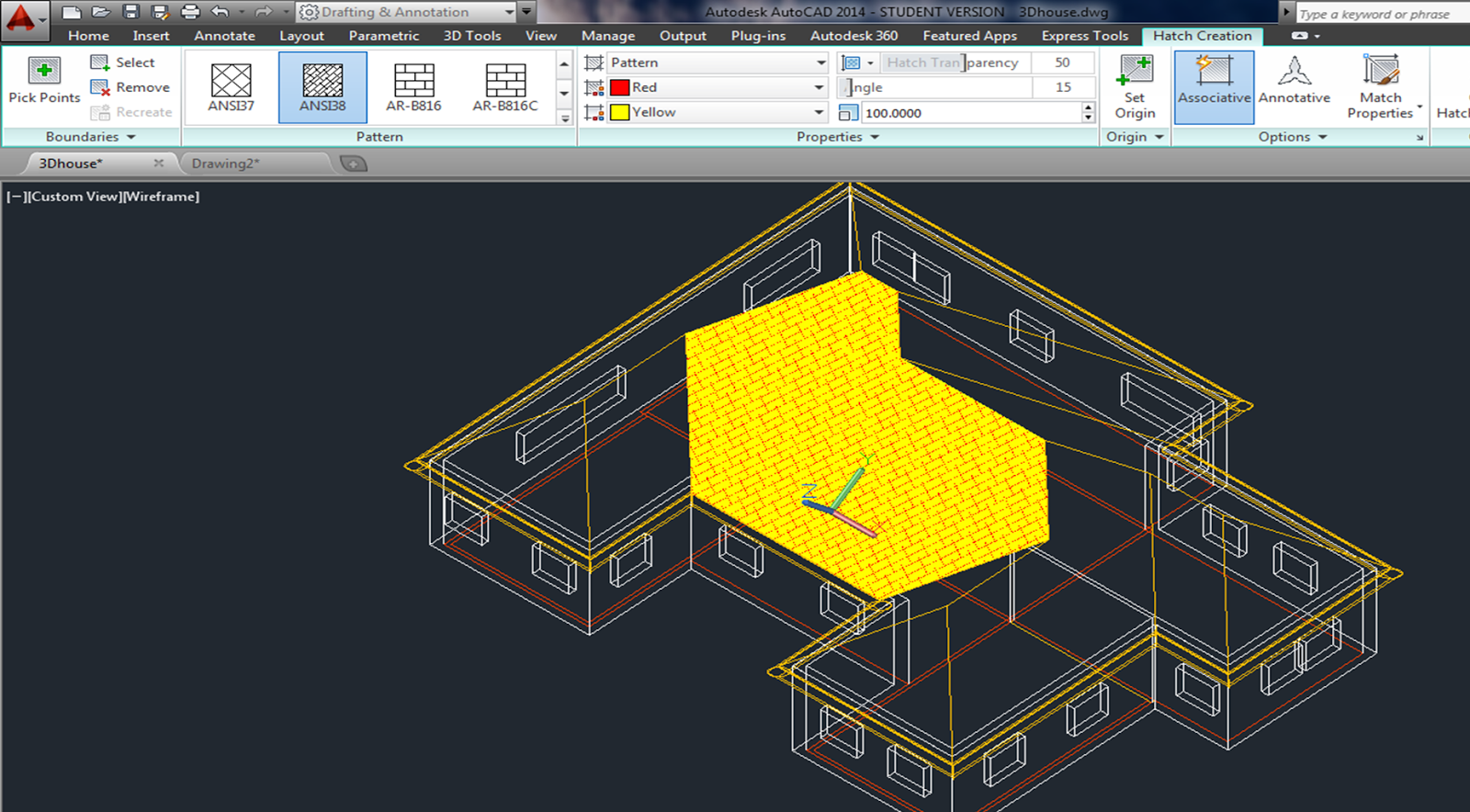
Now, use the hatch command.  Notice that you can only hatch in the XY plane. 

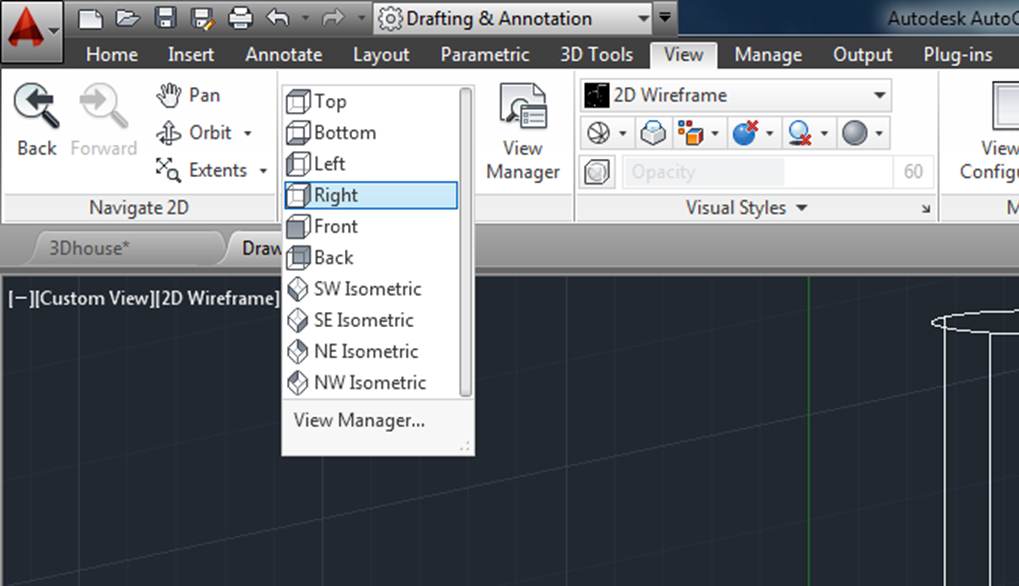
You need to change your coordinate system to hatch all of the sides - just rotate the coordinate system onto the face that you want to hatch, either with the view menu,


or move the coordinate system by typing in UCS and choose "face", and click on the face you want the xy plane on.  (Note, it might be easier to do this from a "conceptual" rather than "wireframe" view)


Note: You can always return to the original UCS by typing in UCS - and then World.


Select hatch, and use "Match properties" so you don't have to re-define your hatch pattern for each wall etc.


Animation:

Camera moving around your object. 


1. Create a 3D model

2.  Draw a pathway around the house (PLINE)


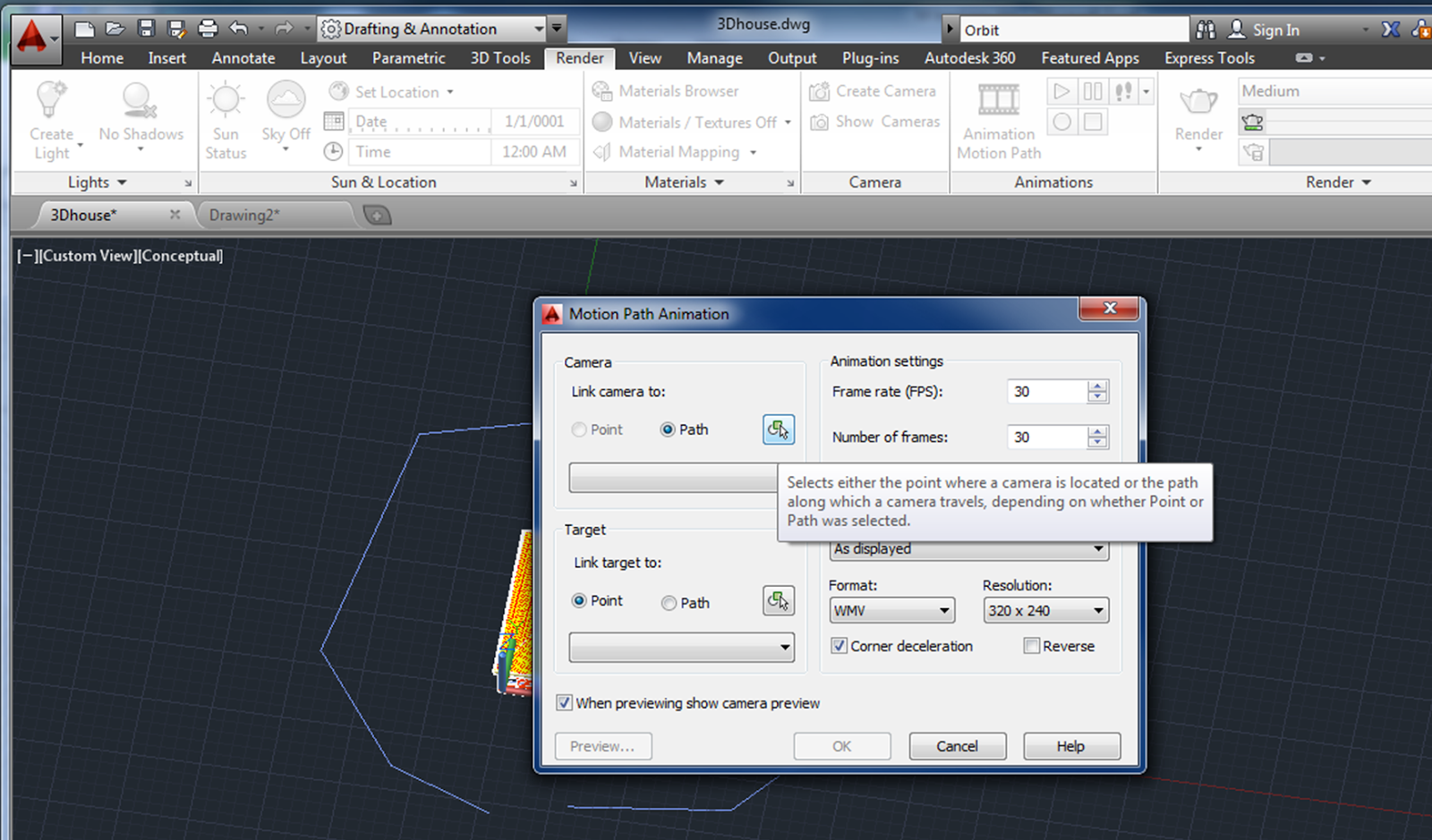
3. Type in ANIPATH   (RENDER -  ANIMATION MOTION PATH - to get render toolbar, right click on grey area, show tools, and show render)


4. Define where camera is at, and where camera is looking.

Link Camera - where the camera is
Link target - where the camera is looking


5. Keep previewing and playing around with it until you get a good sweep. 

Example youtube explaining it:


http://www.youtube.com/watch?v=xmE7UEiE1Nc


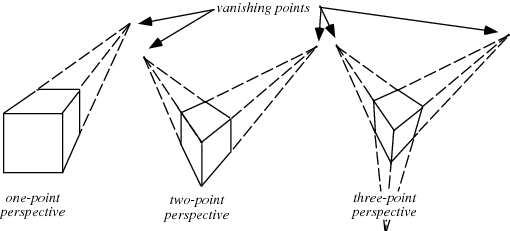
Remember Perspectives?


1. Single Point Perspective - use for interior views.
Keep the target and the camera at the same height and the line of sight either horizontal or vertical. 

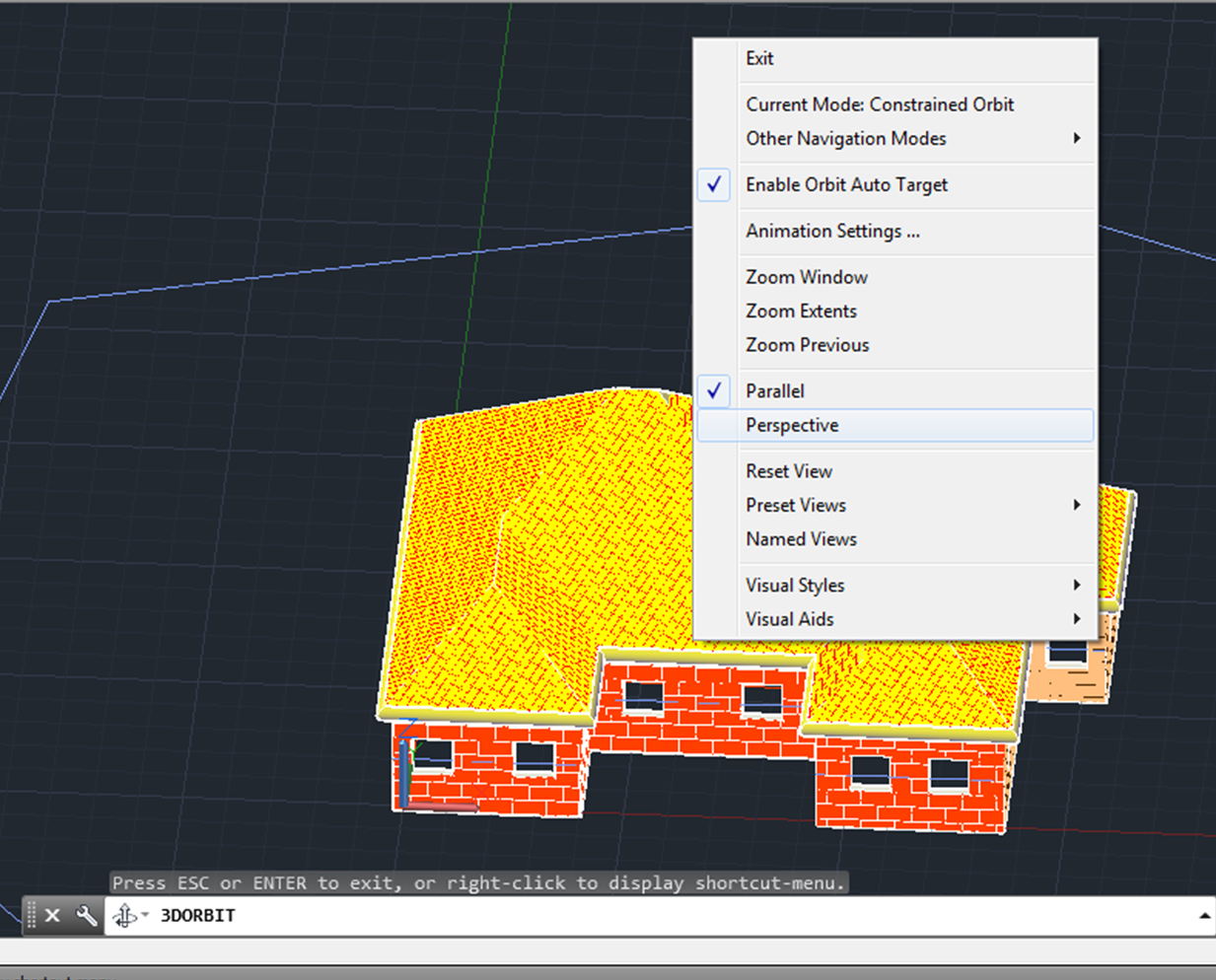
Type ORBIT (or 3DORBIT)
right click


Select "Perspective"
Hold down the shift + left mouse button, then use the scroll, and see if you can do a "walk through" of your house.


Look up "ORBIT" in the AutoCAD help menu, or on youtube, for more info.


Thursday, March 20, 2014

Mechanics of Materials


Mechanics of Materials
.
A big part of your design, is a consideration of the material that you are using. 

.
Mechanics of Materials is the study of the mechanical properties of ceramics, metals, and polymers, and the role of processing and microstructure in controlling these properties.
.

 .
Common Material properties to consider:
Ductility, strength, hardness, thermal expansion, thermal conductivity, electrical conductivity, corrosion properties, melting point, density, etc.

.
Young’s modulus  or tensile modulus, or elastic modulus:.

.


.

Shear Modulus (or
Modulus of Rigidity)
elasticity for a shearing force.
"the ratio of shear stress to the displacement per unit sample length (shear strain)"
.


Shear Modulus for common materials
http://www.engineeringtoolbox.com/modulus-rigidity-d_946.html


Poisson’s ratio:
.


Mechanical Properties of Wood:.


http://www.conradlumberco.com/pdfs/ch4-Mechanical-Properties-of-Wood.pdf

Wood: natural, heterogeneous material with knots, splits, non-uniform grain, and variable properties. 

Testing
Clear – no knots, uniform straight grain, no splits, homogeneous, defined moisture content - ideal case giving the largest values of forces.  (Generally, knots etc. lower strength properties)
Lots of tests, get average values with large standard deviations. 

Orthotropic Nature – Strength properties depend on orientation of grain to force.


Because wood is orthotropic, there are 12 different strength measurements:
3 different Young's modulus (one for each direction)
3 Shear modulus (G)
6 Poisson’s ratios

Example tables:
http://www.conradlumberco.com/pdfs/ch4-Mechanical-Properties-of-Wood.pdf


Metals:
14 basic bravais-lattices structures of atoms:


Materials properties are controlled by how easily planes of atoms can slide over one another.  Cubic lattice structures allow slippage to occur more easily than non-cubic lattices, and so are more ductile.
.
Solidification:


Multiple solid crystals (or grains) begin to grow in cooling liquid
Nucleation - when crystals (grains) start to grow


Crystal Packing defects change material properties:

point defects - places where an atom is missing or irregularly placed in the lattice structure. Point defects include lattice vacancies, self-interstitial atoms, substitution impurity atoms, and interstitial impurity atoms.


 linear defects - which are groups of atoms in irregular positions. Linear defects are commonly called dislocations.


planar defects - which are interfaces between homogeneous regions of the material. Planar defects include grain boundaries, stacking faults and external surfaces.


Grain boundaries - stop slip planes, and strengthen materials.
The size of the grains depends on how fast you cool it, and how many nucleation sites you get.


Phase diagram of solidification:


Steel
.


Steel is an iron alloy, with up to 2.1% Carbon by weight. 
Alloy - mixture of a metal + non-metal

Low carbon steel (mild steel) contains less than 0.3% carbon.

Medium carbon steels contain carbon from 0.3 -0.55%.

High carbon steel contain more than 0.5% carbon.

Iron with more than 2% carbon is referred to as Cast Iron.
.
Effect of Carbon on steel:.
Increase in carbon in steel:
1) Decreases the ductility of steel.
2) Increases the tensile strength of steel
3) Increases the hardness of steel.
4) Decreases the ease with which steel can be machined.
5) Lowers the melting point of steel.
6) Makes steel easier to harden with heat treatments.
7) Lowers the temperature required to heat treat steel.
8) Increases the difficulty of welding steel.
.
Steel with 0.2% Carbon can attain Rockwell C hardness of 49, while an 0.8% carbon steel can be hardened to Rockwell C of 65.
As carbon is added, steel gets harder and becomes difficult to machine.
.
Example: steels for springs must have at least 0.45 % carbon to attain required hardness.

Carbon steels, and alloy steels are designated by a four digit number:
- first digit indicates = the main alloying element(s),
- second digit = the secondary alloying element(s),
- last two digits = the amount of carbon,

Example
1060 steel = a plain-carbon steel containing 0.60 wt% C


Mechanical Properties Polymers:

Polymers - an organic material created with a chain of carbon atoms.  Includes rubber and synthetic materials such as plastics and elastomers. Can have a wide range of mechanical properties and colors.


Made up of chains:

Mer –
  The repeating unit in a polymer chain
Monomer –
  A single mer unit (n=1)
Polymer –
  Many mer-units along a chain (n=103 or more)
Degree of Polymerization –
  The average number of mer-units in a chain.
Applied Stress - chains stretch out. 
Length of the polymer chain:
0-100 atoms = liquid
100 + atoms  = waxy solid
1,000 + = solid (polyethylene etc.) with definable material properties of strength, ductility, hardness, etc.
increased length = increased binding force between molecules.
 Chains are a tangled mess (picture a mass of intertwined worms randomly thrown into a pail)
  
Ceramics:
an inorganic, nonmetallic solid that is prepared from powdered materials and is fabricated into products through the application of heat
Ceramics generally have strong  covalent and ionic bonding which produce:
  •  high hardness,
  • high compressive strength,
  • low ductility
  • low tensile strength 
  • chemically inert
  • Poor electrical and thermal conductors.

 Atomic microstructures widely vary from simple to complex.
  • Glass - amorphous
  • Crystalline
  • Crystalline + glassy


Truss Designs

Truss:Support structure or frame with members connected by joins (or nodes).

Simple truss - uses triangles (stable shape). 

Members in the truss are either in tension, compression, (hopefully not torsion, but it can happen).  Add forces at a join up to solve statics problems.


Truss Terms - http://www.alpeng.com/index.php?option=com_content&view=article&id=73&Itemid=9


Two types of truss:
pitched/common/standard
Parallel/Flat


Parallel truss


Joints can be rigid, semi rigid, or hinged.
Rigid connections - allows transfer of bending moments
hinged - does not transfer bending moments.

Statics - approximates system by applying forces on joins.

Static - sum of forces at a point =0.


Boomilever - https://www.youtube.com/watch?v=wUMa2mvtqiY

Lessons learned - Static and Dynamic systems are very different, when it starts deforming (dynamics) cross members are very important.  (ie Fbc is not 0, BC supports and prevents failure.)

Truss failure:


Material properties:


Strain:


Tension:


Compression:


Look up your material yield strengths, estimate the applied forces, and adjust your cross sectional areas accordingly!

Schedule

Spring Semester 2014


Week 8: March 3-7
Review for Midterm & Midterm,


Mid - Semester Break (offices closed March 10-16)

Week 9: March 17-21
Architectural/Civil Engineering - create house blueprint
Floor plans, walls, ceiling

Week 10: March 24-28
Architectural/Civil Engineering
Truss designs, Statics review, Mechanics of Materials
House presentation.

Last day to drop and receive "W" April 3

Week 11: March 31-April 4
Mechanical Engineering
Design an engine - thermo intro


Week 12: April 7-11
Mechanical Engineering 2


Week 13: April 14-18
Chemical Engineering: Pumps, Valves, pipes. 

Threaded Fasteners: Ch 8
Spring Holiday (offices closed) April 18-20

Week 14: April 21-25
Chemical Engineering 2, & Working Drawings / FEM intro.


Week 15: April 28 – May 2nd:
Project presentations,
Review for Final
Final Exams: May5-11
Grades due(4 pm) May 13
Commencement May9-10

Wednesday, March 19, 2014

Roof

Design your roof!

Do a Google image search on different roof styles, materials, and needs for the climate you are designing for.


Start with your floor plan.

Copy it into a new file (keep a separate file that has just your floor plan).

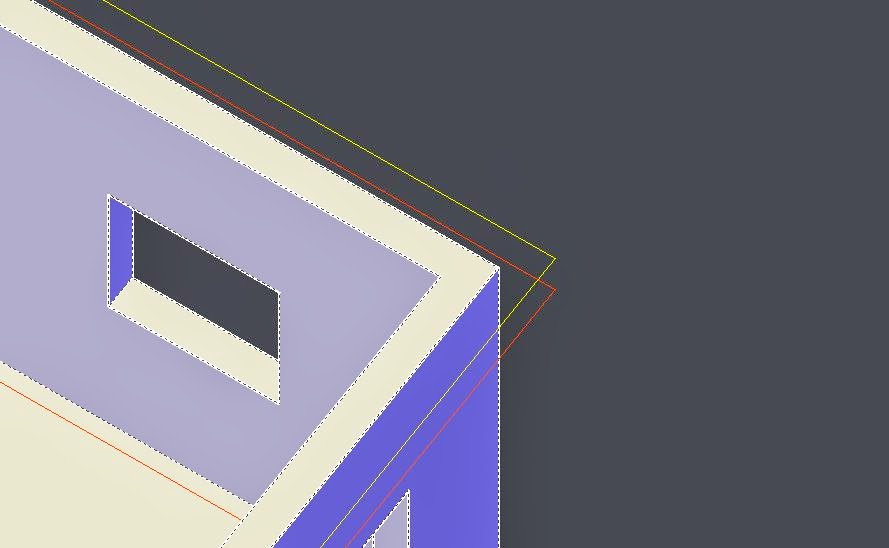
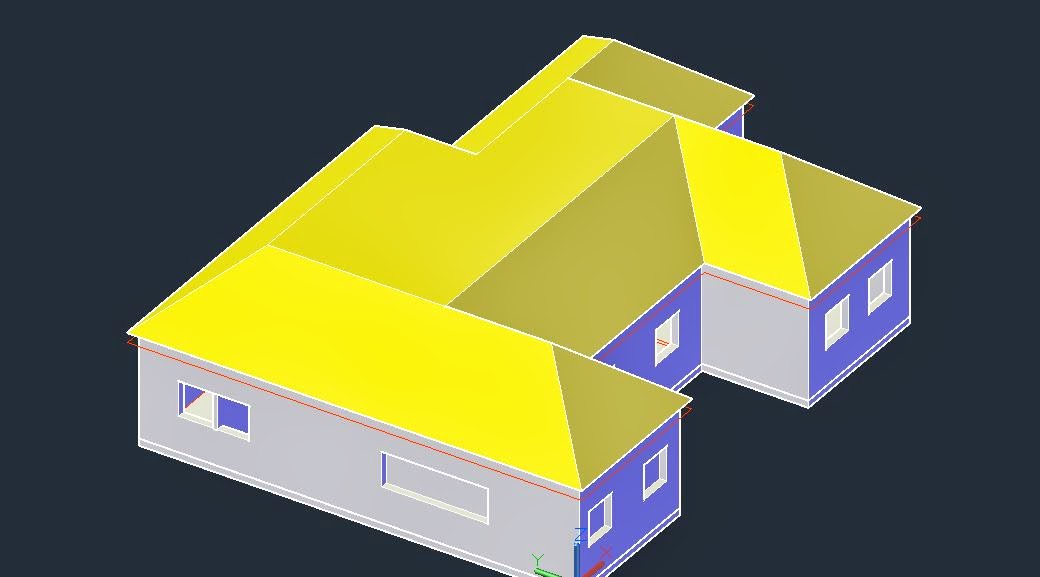
Extrude your walls, cut out windows and doors, then draw a poly line around the entire top of your house, and offset it 12" for the roof.


Copy two offset poly outlines for the top - one for molding/gutter, one to extrude a tapered roof.


Type in EXTRUDE, select offset line, use the taper angle.
Note: it will not let you extrude it all the way up...

To create the entire roof, type in:
SOLIDEDIT
FACE (select the top of the house)
MOVE (pick a random point way above the roof)


Shell command -

To create multiple layers within the roof, make a few copies of your 3D roof, then use different shell thicknesses, and subtract off different layers of the roof.

Do a little research on different types of roofing insulation.


Move the roof up and down until it is just above your walls - decide what type of ventilation you would like.


Use the  sweep command to create molding and gutters.